Sewing for a doll is sewing in miniature. The waist you are fitting is about nine centimetres around, a seam allowance is three or four millimetres, and a sleeve is the size of your thumb. None of that is hard, but it is different, and most of the trouble beginners run into comes from treating a doll pattern like a scaled-down version of a human one. This guide covers what we tell people who sew our patterns for the first time: which pattern to start with, how to pick the right fit for your doll, what the lines on the pattern mean, which fabric to use and how to sew seams that small.
Our patterns are made for 11.5 inch fashion dolls such as Barbie®, drafted by hand on graph paper and sewn up on the real doll before they are digitised. Everything below applies to them; most of it applies to any doll pattern.
Start with the right body, not the right dress
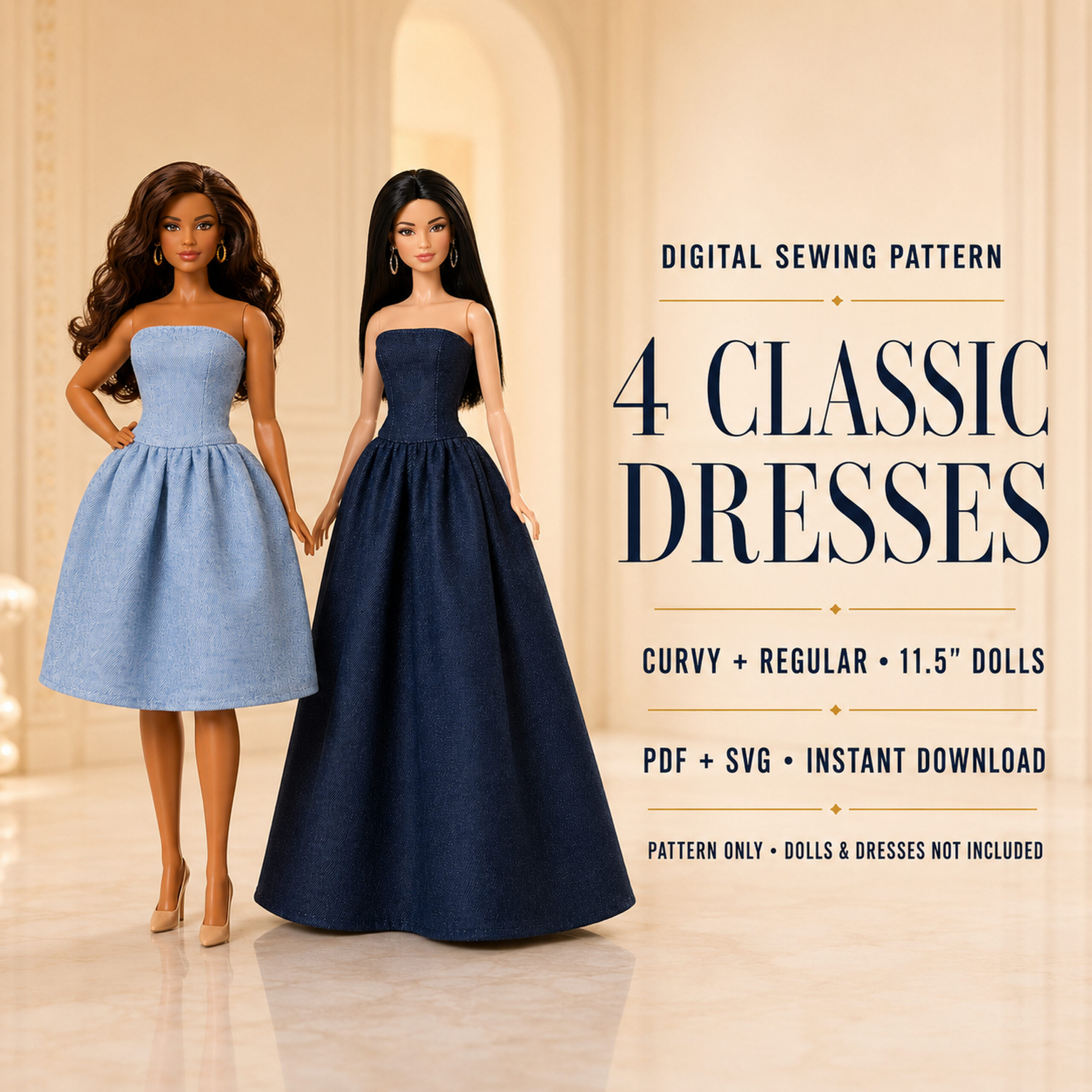
Fashion dolls come on different bodies, and the difference is bigger than it looks. Mattel sells Barbie® Fashionistas on four of them, Regular (the original), Curvy, Petite and Tall, and a Curvy waist is more than a centimetre wider than a Regular one. A dress cut for one will not close on the other.
Every one of our patterns says which bodies it was fitted on, and they are not all the same:
- Cocktail and evening dress and evening gowns have separate pattern pieces for Regular and Curvy dolls.
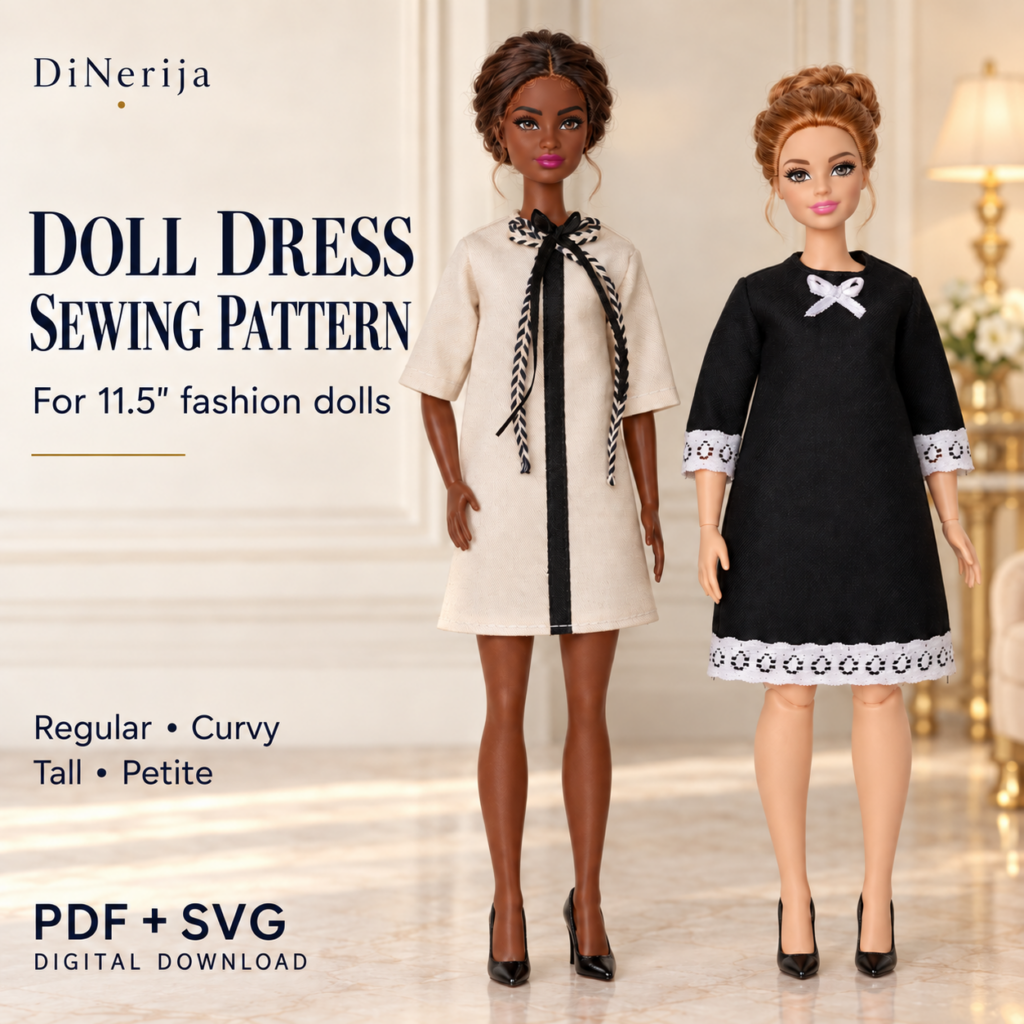
- Long sleeve dress is an easy-fitting shape, so one set of pieces fits Regular, Curvy and Tall.
- Fitted dress with overskirt is shaped with darts and made for Regular dolls only.
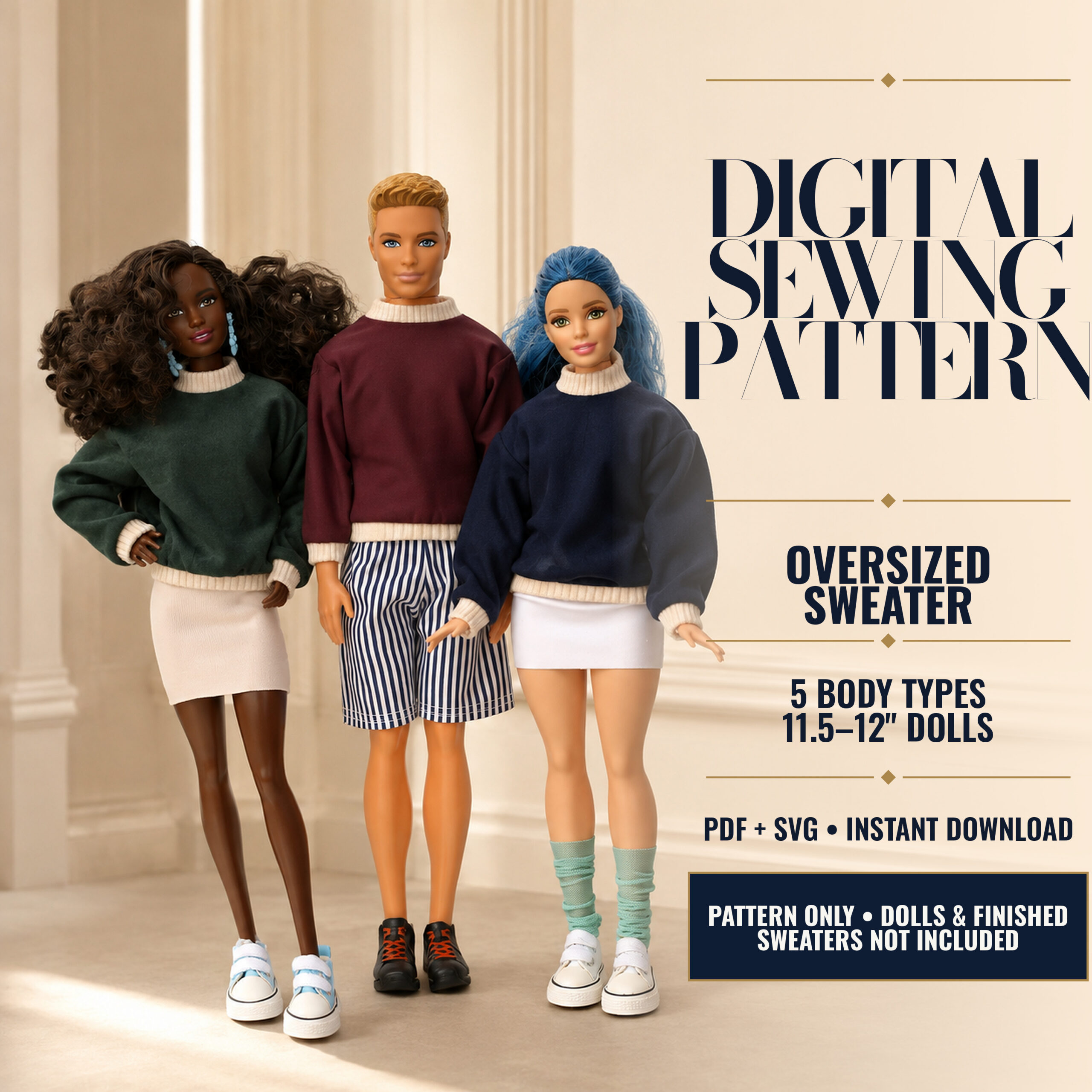
- Oversized sweater is roomy by design and fits all four bodies plus 12 inch male dolls such as Ken®.
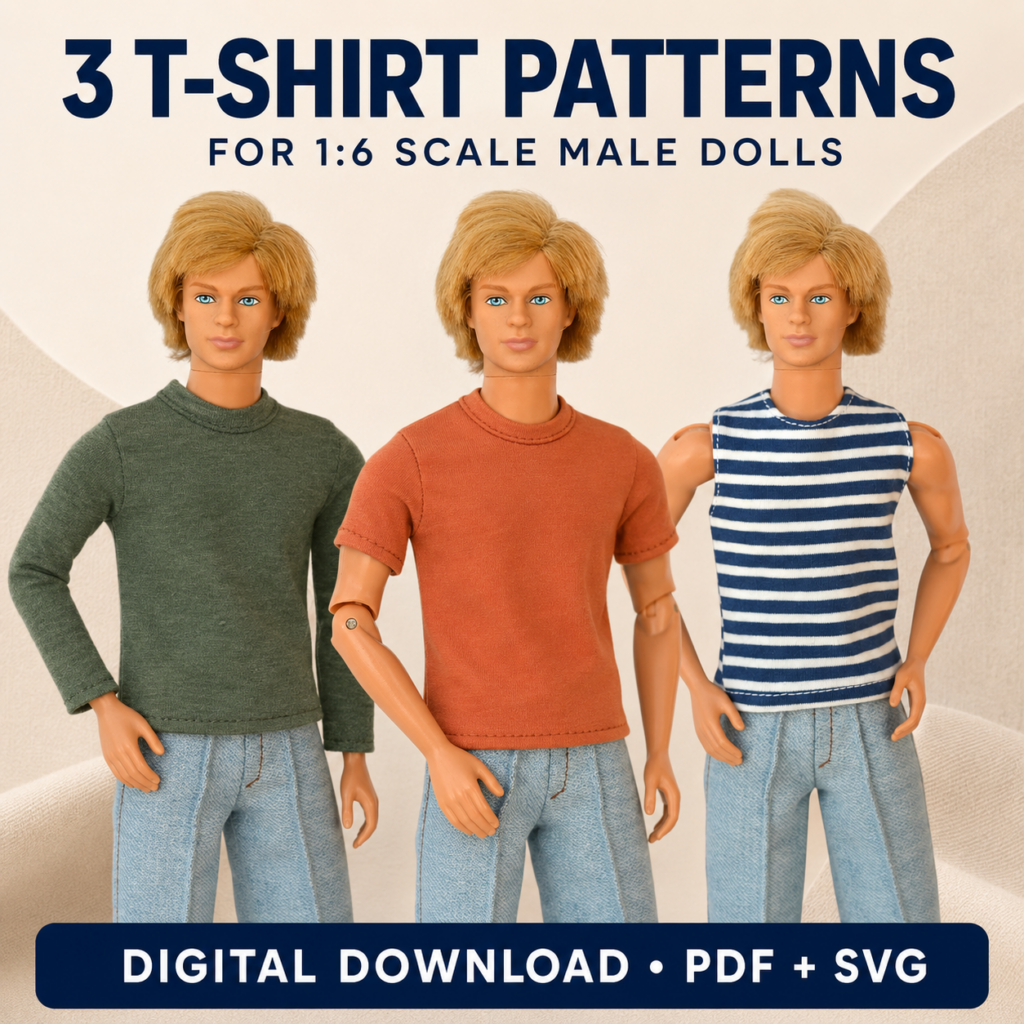
- T-shirts for male dolls are for 12 inch male fashion dolls.
If you are not sure which body your doll has, the Size Guide has photos, measurements and a table of which Barbie® line is which size. Check it before you buy, not after you cut.
Print at 100% and measure the test marks
Every pattern sheet has a 1 cm and a 1 inch mark on it. After printing, put a ruler on them. If they measure true, the pattern is the right size. If they do not, the printer scaled the page: open the PDF in a PDF reader, not a browser, and choose "Actual size" or "100%" in the print window, with "Fit to page" turned off. On a human pattern a 3% error is invisible; on a doll bodice it is the difference between a dress that closes and one that does not. The files are made for both A4 and US Letter.
Read the lines before you cut
Our PDF + SVG patterns include the seam allowance, about 3 to 4 mm, and each product page says so. The pieces show two lines: a dashed seam line, where you sew, and an outer cut line, where you cut. Do not add anything. Beginners sometimes add a "safe" extra 5 mm as they would on a blouse, and the dress comes out a size too big.
Fold lines mean the piece is cut on folded fabric and opens into one symmetrical part. Small marks on the seam lines show where pieces meet; they matter more at this scale than at full size, because a millimetre off at the shoulder shows at the hem.
Choose the fabric the pattern asks for
This is the single most common reason a doll garment disappoints. Each of our product pages names the fabric type the pattern was designed for, and swapping it changes the fit.
- Non-stretch woven fabric for the structured pieces: the cocktail and evening dresses, the long sleeve dress, the fitted dress. Think light cotton, lawn, fine poplin, thin linen. A woven keeps the shape of a bodice and a gathered skirt.
- Stretchy knit for the pieces that have to slip on: leggings and tube tops, the T-shirts (spandex or stretch cotton) and the oversized sweater (jersey, stretch cotton or a polyester knit). A knit gives the stretch that lets a garment with almost no seam allowance go over the doll's hips.
- Thin, not thick. Fabric does not scale down. Quilting cotton is fine; denim, fleece and heavy jersey make seams that stand up like cardboard. For a first sweater, avoid very thin see-through knits too; they are harder to handle.
- Small prints. A print that looks fine on a cushion looks like wallpaper on a doll. Tiny florals, pin dots and narrow stripes read as fabric at 1:6 scale.
Cutting pieces the size of a stamp
- Trace the pattern onto the wrong side of the fabric with a sharp pencil or chalk pencil, then cut on the line. Pinning paper to such small pieces distorts them.
- Use small, sharp scissors. Embroidery scissors or a small fabric pair are easier to steer around a neckline than dressmaking shears.
- Hold pieces together with small clips or fine pins placed inside the seam allowance. Ordinary pins leave holes in fine fabric.
- If you have a cutting machine, our patterns come with SVG files for exactly this reason: the small pieces come out identical every time.
Sewing a 3 mm seam
A sewing machine helps but is not required; every one of our patterns can be sewn by hand with a small backstitch. On a machine, shorten the stitch to about 2 mm so a seam that is only a few centimetres long has enough stitches to hold, and sew slowly. Use the edge of the presser foot as a guide for the allowance.
Press after every seam, with the iron tip. On a garment this small, pressing does half the work of fitting: a pressed dart lies flat, an unpressed one makes a bump. Finishing seam edges is usually not needed; the allowance is too narrow to fray much and it sits inside the garment.
Closures are small hook-and-loop tape or snaps at a back opening. Our patterns are drafted for these, so the back edges have room for them. Sew the closure on before you sew the last seam that closes the back, while the piece still lies flat.

Which pattern to sew first
- Never sewn for a doll: the no-sew set needs scissors only, and leggings and top is five knit pieces at 15 to 20 minutes each.
- Comfortable with straight seams: the long sleeve dress or the oversized sweater, both beginner level with step-by-step photo instructions; the dress also comes with a short version for people who do not need them.
- Want a challenge: the fitted dress with overskirt has darts, curved edges and a back closure. It is marked intermediate for a reason, and it is the one that teaches the most.
Questions we get
Do I need a sewing machine?
No. The seams are short, and a small backstitch by hand is strong enough. A machine is faster once you are used to feeding tiny pieces through it.
Is the seam allowance included?
On our PDF + SVG patterns, yes, about 3 to 4 mm, with the seam line and the cut line both marked. Do not add more. Each product page states what the pattern includes.
Can I sell what I sew from your patterns?
Yes, in small quantities, with a credit to "Pattern by DiNerija". Sharing or reselling the pattern files themselves is not allowed. The full licence is on each product page.
Which dolls do the patterns fit?
11.5 inch fashion dolls such as Barbie®, with the body types listed on each pattern, and 12 inch male dolls such as Ken® for the sweater and the T-shirts. Dolls are not included; the names are used only to show fit.
All patterns are in Sewing Patterns. Each download includes step-by-step photo instructions, the pattern sheets for A4 and US Letter, and SVG files for cutting machines.